Cell dynamics on energy landscape: Comparing attractor detection in Boolean network and diffusion-based models under in silico gene perturbations
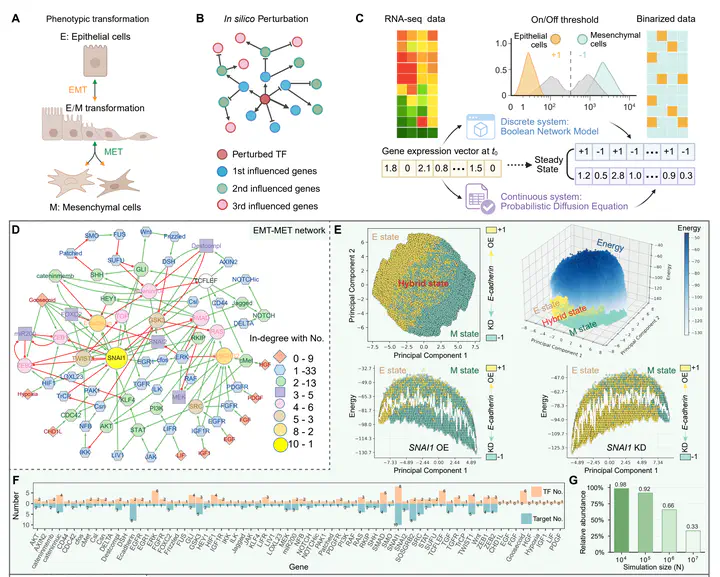 Image credit: [Lingyu Li]
Abstract
Steady-state attractor detection differs fundamentally between discrete Boolean network (BN) and continuous diffusion-based models because they operate on different state spaces and exhibit distinct dynamic behaviors. Here, we propose CellLand (Cell dynamics on energy Landscape) to systematically compare BN- and diffusion-based approaches for quantifying cellular dynamics on the energy landscape, with a particular focus on attractor identification under in silico gene perturbations. Although the energy landscape provides a unifying conceptual framework, BN-based models face specific challenges, including state-space explosion and pronounced sensitivity to network architecture, when assessing attractor stability and transition accessibility. Nevertheless, BN-based analyses can remain reliable and interpretable when the underlying network topology is suitable, while being comparatively less sensitive to parameter-estimation uncertainty and technical noise. Importantly, we show that attractor identification depends critically on network structure, and that no general theory currently exists for optimizing BN topology for dynamic cell-state modeling. Our findings deepen the comparative understanding of BN- and diffusion-based frameworks and provide practical guidelines for selecting and designing models for robust simulation of complex gene-regulatory systems under perturbations.
Supplementary notes can be added here, including code, data, math, and images.

Lingyu Li
Postdoctoral Fellow
Research in bioinformatics, including spatial transcriptomics, sparse statistical learning, and biomarker discovery.