Compact finite-difference method for 2D time-fractional convection–diffusion equation of groundwater pollution problems
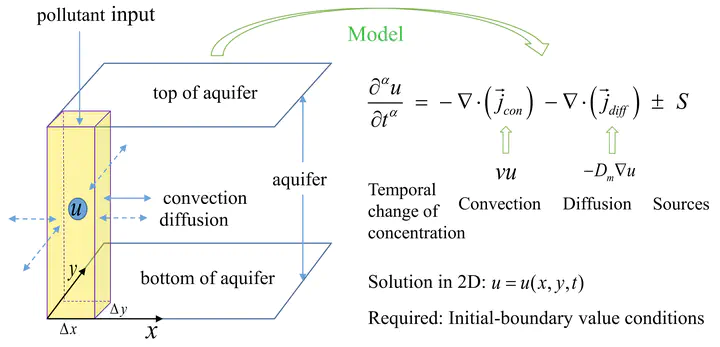 Image credit: Unsplash
Abstract
In this work, we provide a compact finite difference scheme (CFDS) of 2D time-fractional convection-diffusion equation (TF-CDE) for solving fluid dynamics problem especially groundwater pollution. The successful predication of the pollutants concentration in groundwater will greatly benefit the protection of water resources for provide the fast and intuitive decision-makings in response to sudden water pollution events. Here, we creatively use the dimensionality reduction technology (DRT) to rewrite the original 2D problem as two equations, and we handle each one as a 1D problem. Particularly, the spatial derivative is approximated by fourth-order compact finite difference method (CFDM) and time-fractional derivative is approximated by $L_{1}$ interpolation of Caputo fractional derivative. Based on the approximations, we obtain the CFDS with fourth-order in spatial and $(2-\af)$-order in temporal by adding two 1D results. In addition, the unique solvability, unconditional stability and convergence order $\mathcal{O}(\tau^{2-\af} + h_{1}^4 + h_{2}^4)$ of the proposed scheme are studied. Finally, several numerical examples are carried out to support the theoretical results and demonstrate the effectiveness of the CFDS based DRT strategy. Obviously, the method developed in 2D TF-CDE of groundwater pollution problem can be easily extended for other complex problems.
Supplementary notes can be added here, including code, math, and images.

Lingyu Li
Postdoctoral Fellow
Focus on bioinformatics, including but not limited to spatial transcriptomics analysis, sparse statistical learning and biomarker identification.