getDNB: identifying dynamic network biomarkers from time-varying gene regulations utilizing graph embedding techniques
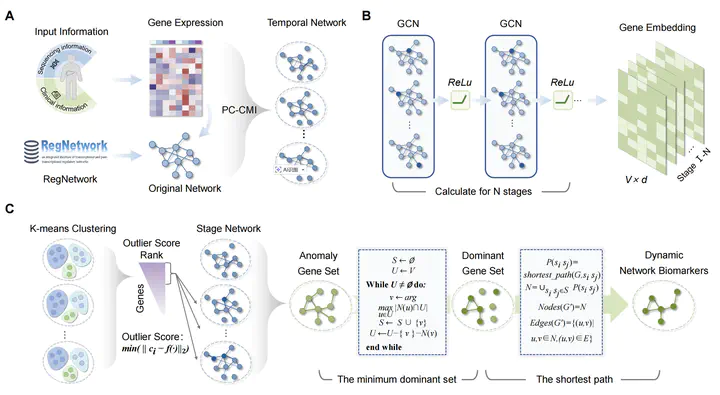 Image credit: [Lingyu Li]
Abstract
Hepatocellular carcinoma (HCC) remains difficult to detect early because conventional diagnostics rely on static biomarkers that emerge late. We present getDNB, a computational framework that identifies dynamic network biomarkers (DNBs) from temporally evolving gene regulatory networks via graph embeddings and anomaly detection. Briefly, getDNB has three steps: (i) construct stage-specific regulatory networks to capture molecular dynamics during HCC progression; (ii) use graph convolutional networks to derive topology-preserving low-dimensional embeddings; and (iii) quantify gene-level abnormalities via K-means clustering and outlier scores, then refine candidates using minimum dominating set and shortest-path criteria to ensure connectivity and reduce redundancy. Moreover, we define the Dynamic Network Index (DNI) to quantify temporal disorder and flag critical transition states. Applied to a real-world HCC dataset, getDNB identified 33 robust DNBs and their interaction network, achieving high predictive accuracy (AUROC = 0.929). Notably, the DNI showed a pronounced increase at the pre-disease stage, consistent with complex systems transition theory. Functional enrichment associated these DNBs with oncogenic pathways, including hepatocellular carcinoma, hepatitis B infection, and cell cycle regulation.
Supplementary notes can be added here, including code, data, math, and images.

Lingyu Li
Postdoctoral Fellow
Focus on bioinformatics, including but not limited to spatial transcriptomics analysis, sparse statistical learning and biomarker identification.