 Image credit: Lingyu Li
Abstract
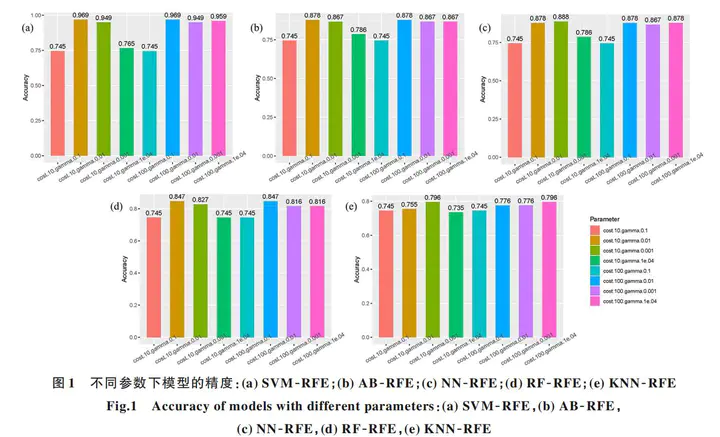
In recent years, the identification of descriptive genes of biomarkers based on gene expression microarray data has attracted much attention in the field of bioinformatics. The successful identification of spontaneous preterm birth (SPTB) biomarkers is conducive to reducing the risk of preterm birth in pregnant women and has important research value. In this paper, we propose a method for identifying biomarkers of SPTB from publically available gene expression data. First, it downloads SPTB gene expression data from public databases, uses SVM-RFE for gene feature selection, and compares it with other machine learning and feature selection methods, namely AB-RFE, NN-RFE, RF-RFE and KNN-RFE. With the help of accuracy (Acc), precision (Pre), sensitivity (Sn), specificity (Sp), F-measure and AUC value, the classification performances are evaluated. Then, the top-ranked genes of SVM-RFE are intersected with the top-ranked genes of the other four methods as the identified SPTB biomarkers, which are sequentially justified by cluster analysis, correlation analysis and functional enrichment analysis. Finally, an SVM classifier is constructed to verify the identified biomarkers on an independent dataset. The results show that machine learning methods are effective for SPTB biomarkers discovery. This method can realize the possibility of SPTB non-invasively before women’s pregnancy, reduce the dependence on artificial identification, and reduce the risk of premature delivery of pregnant women.
Supplementary notes can be added here, including code, data, math, and images.

Lingyu Li
Postdoctoral Fellow
Focus on bioinformatics, including but not limited to spatial transcriptomics analysis, sparse statistical learning and biomarker identification.